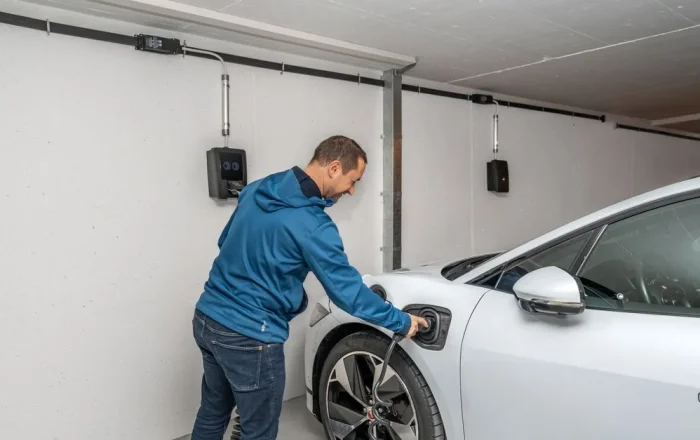
I get this question almost every week from people mid-install, usually holding a coil of 4-gauge wire and staring at their engine bay wondering if they really need to spend another 300 dollars. The honest answer: if your lithium battery is ever charged from the vehicle’s alternator, you need a DC-DC charger. There are a small number of exceptions, and we will cover those too, but for the vast majority of van, RV and boat conversions this is not optional equipment.
The quick version
- If you charge lithium from the alternator (through your chassis battery or a direct feed), you need a DC-DC charger.
- If you only charge from solar and shore power, you do not need one at all.
- A basic isolator or solenoid is not a substitute because it cannot manage voltage or current for LiFePO4.
- Vehicles with smart or variable-voltage alternators (most 2013+ vehicles) make a DC-DC charger even more necessary, not less.
- Budget 300 to 700 dollars total for a properly sized, properly wired setup.
The one-question test
Here is the test I use with everyone who emails me confused about this. Ask yourself: does a wire run from my starter battery or alternator output to my lithium house bank, in any form? If yes, you need a DC-DC charger between them.
It does not matter if that wire currently has a switch, a solenoid, a fuse, or nothing at all. Any electrical path between a lead-acid starting battery and a lithium house bank needs to be managed, and a DC-DC charger is the tool that does the managing.
If your only charging sources are solar panels and an AC charger plugged into shore power or a generator, you can skip this entire category of gear. Those systems already have their own charge controllers built to lithium profiles.
Why lithium and alternators do not mix directly
LiFePO4 batteries have extremely low internal resistance compared to lead-acid or AGM. That is part of why they charge so fast, but it is also the problem. Wired straight to an alternator, a lithium bank will try to pull as many amps as the alternator can physically produce, with almost nothing limiting that current.
A stock alternator rated for 120 amps was designed to feed a lead-acid battery that tapers its own current draw as it fills. Lithium does not taper the same way until it is nearly full, so the alternator can end up working at max output for extended periods, generating heat it was never designed to shed continuously.
Warning: I have seen two cooked alternators in the past three years from people who wired lithium straight to the chassis battery “because it was working fine.” It worked fine for six weeks, then it did not. For the full explanation of why this specific wiring mistake is so common, read why you can’t wire lithium to the alternator.
A DC-DC charger sits in that path and does two jobs: it limits current to a safe, chosen amperage, and it converts whatever voltage the alternator happens to be producing into a proper multi-stage lithium charge profile, typically bulk around 14.2 to 14.6V, then absorption, then float.
The smart alternator problem
This is where things get trickier than they used to be. Most vehicles built since roughly 2013, including a lot of Ford Transits, Ram ProMasters, and newer Sprinters, use smart or variable-voltage alternators controlled by the engine computer for fuel economy.
These alternators do not hold a steady 14.4V. They might sit at 12.8V at idle, spike to 15V under load, or drop to 12V once the vehicle’s computer decides the starter battery is full enough. A basic isolator relay just passes that unpredictable voltage straight through, which is exactly wrong for lithium.
A DC-DC charger with a smart-alternator or “ignition-controlled” input, like the Victron Orion XS or Renogy DCC series, ignores the noisy alternator voltage and instead uses its own internal charging algorithm. It only cares that the ignition is on and there is a reasonable voltage present to draw from. This is genuinely the main reason DC-DC chargers replaced simple isolators as the standard approach industry-wide.
We cover this exact issue in more depth in our smart alternators and lithium charging guide if your vehicle is a newer model and you are not sure what type of alternator it has.
A real scenario: the Sprinter build that almost skipped it
A reader named Dana wrote me last spring about her 2021 Sprinter conversion. She had a 280Ah Battle Born-equivalent lithium bank, solar on the roof, and was ready to skip the DC-DC charger to save money and complexity, planning to rely on solar alone.
The math looked fine on paper for summer camping in Arizona. Then she took a work trip through the Pacific Northwest in November, four days of driving through overcast forest roads with barely any usable solar. Her battery dropped to 20 percent with no way to recover it short of a campground hookup.
She ended up installing a 40-amp DC-DC charger after that trip, wiring it to the Sprinter’s ignition-controlled auxiliary battery terminal. Now every hour of driving adds meaningful charge regardless of weather, which is really the whole point of having one in a rig that moves.
When you genuinely do not need one
To be fair, there are legitimate setups where a DC-DC charger is not needed. Boats with no engine-to-house electrical connection at all, cabins on trailers that are never towed by a vehicle with a usable alternator feed, and solar-only stationary systems all fall outside this need.
Some boat owners charge purely from shore power and solar with the engine’s alternator dedicated only to starting batteries, in which case there is nothing to connect. If that describes you, our guide on charging boat lithium from the engine walks through when it does make sense to add that connection later.
One more exception worth mentioning: if you already have a high-output lithium-specific alternator installed (rare, and expensive) that is professionally regulated to lithium-safe voltage and current limits, you may not need a separate DC-DC charger. That is not the same as “my alternator seems fine so far.”
What size charger you actually need
Once you have confirmed you need one, sizing depends on your battery capacity, how much driving time you typically get, and what your alternator can spare without straining. Common sizes are 20, 30, 40, and 60 amps, with the Victron Orion XS and Renogy DCC lines covering most of that range.
| Setup | Typical charger size | Approx. cost |
|---|---|---|
| Single 100Ah battery, occasional driving | 20-30A | $180-280 |
| 200-280Ah bank, daily driving | 40A | $260-380 |
| 400Ah+ bank, long road trips | 50-60A | $400-600 |
We go through the full sizing math, including alternator headroom and wire gauge, in how to size a DC-DC charger. Do not just buy the biggest one available; oversizing wastes money and can pull more from the alternator than your wiring or the alternator itself can safely handle.
Tip: Check your specific vehicle’s alternator output and factory wiring before buying anything. Manufacturers like Victron publish compatibility notes for smart-alternator vehicles on their Orion XS product page, and it is worth five minutes of reading before you order.
Putting it together
For the complete picture on how DC-DC chargers work, how they compare across brands, and how to wire one properly once you have decided you need it, our full guide to DC-DC chargers for lithium is the best next stop. It covers everything from ignition wire triggers to fusing on both ends of the run, following ABYC E-11 guidance for DC electrical systems.
If you take one thing from this article, let it be this: the question is not really about your battery, it is about your alternator connection. Trace that wire, answer honestly, and size accordingly. Most people who ask me this question already have their answer, they just wanted someone to confirm it before they spent the money.